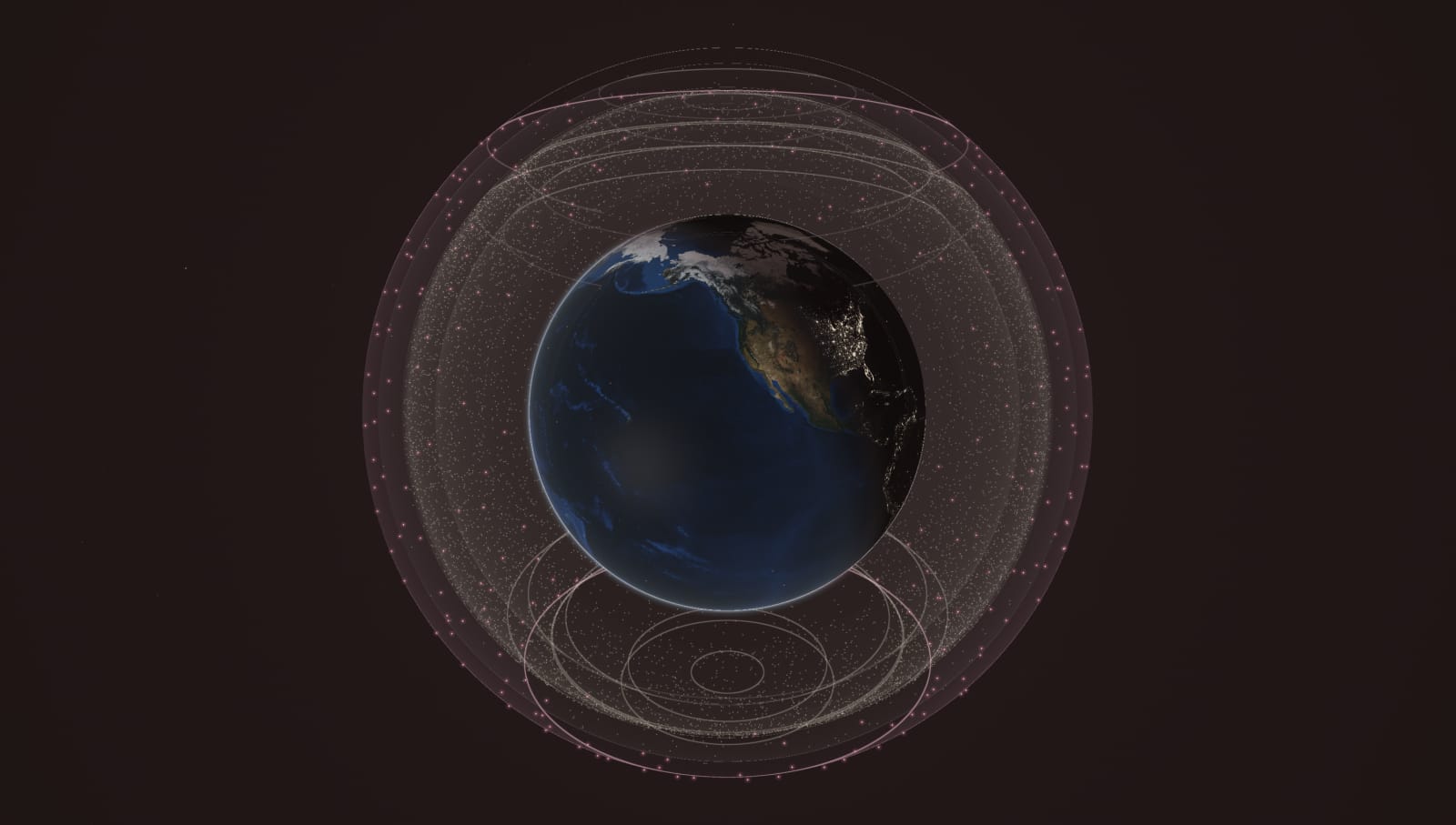
This page is the log: satellites, rockets, FCC filings and Amazon's service targets, each with its date, its source and how sure it is. Looking for when home service starts? That's on the launch-date page. Want to know if you can order it? See availability.
The count today
- satellites in orbit, our tally of tracking data (Amazon says "nearly 400")
- 392 Our calculation checked
- launched in all, counting the 2 prototypes from 2023
- 398 Our calculation checked
- last launch; none since
- Jul 2, 2026 Confirmed checked
- next launch with an announced date (LV-01), targeted, pending range approval
- Nov 13, 2026 Planned checked
Satellites in orbit
The line climbs with each launch and steps down when a satellite reenters the atmosphere. It has been flat since July: Amazon's last Atlas V has flown, and the next rockets in line have had setbacks (see the launch log).
Satellites in orbit, by date
Amazon Leo satellites in orbit: 392 on Nov 2, 2026, with no launch since Jul 2, 2026
A launch (count in orbit just after it) Planned launch (date not final) Latest tracker count
Step line of Amazon Leo satellites in orbit from 2024-12-01 to 2026-10-24. It rises with each of 15 launches, from 2 prototypes in 2023 to 394 after the launch on 2026-07-02, then steps down as satellites reenter, to 392 on 2026-10-24. The table below the chart lists every point.
Show the numbers as a table
| Date | Mission or point | Launched on it | Launched in all | In orbit after |
|---|---|---|---|---|
| Protoflight | 2 | 2 | 2 | |
| KA-01 | 27 | 29 | 28 | |
| KA-02 | 27 | 56 | 54 | |
| KF-01 | 24 | 80 | 78 | |
| KF-02 | 24 | 104 | 102 | |
| KA-03 | 27 | 131 | 129 | |
| KF-03 | 24 | 155 | 153 | |
| LA-04 | 27 | 182 | 180 | |
| LE-01 | 32 | 214 | 211 | |
| LA-05 | 29 | 243 | 239 | |
| LA-06 | 29 | 272 | 268 | |
| LE-02 | 32 | 304 | 300 | |
| LA-07 | 29 | 333 | 329 | |
| LE-03 | 36 | 369 | 365 | |
| LA-08 | 29 | 398 | 394 | |
| FCC 50% milestone date | 0 | 398 | 392 | |
| latest tracker update | 0 | 398 | 392 |
Reentries (the line's small steps down): 2024-09-29, 2025-04-29, 2026-02-08, 2026-03-02, 2026-07-27, 2026-07-28.
How we count
In orbit = launched minus reentered: 398 Our calculation checked satellites launched (including 2 prototypes) minus 6 that came back down. Jonathan McDowell's tables, a tracker that draws on US Space Force data, give the same total, so we label the count "our calculation", not an Amazon figure.
Not every satellite in orbit is in its working orbit yet. McDowell's breakdown for the same date:
- 368 in their working orbit
- 12 still climbing to it
- 4 drifting to their orbital plane
- 7 held in reserve or moving
- 1 lowered out of the constellation
Caveat from the tracker: McDowell: 'satellites that are not in the operational orbit may nevertheless be providing operational service.' Orbit status says nothing about whether a satellite carries customer traffic.
Against the FCC's first deadline: about a quarter of the satellites required
- In orbit that day
- 392 Our calculation (24.3% of the milestone)
- Half-way milestone
- 1,616 Confirmed by Jul 30, 2026
- Full system
- 3,232 Confirmed by Jul 30, 2029
Checked · FCC numbers from the license and DA 26-553; the share is our arithmetic.
On the same count: Starlink, OneWeb and Amazon Leo
All three numbers come from one tracker (McDowell's tables, updated the same day), so they compare like with like. Starlink and OneWeb are shown only as yardsticks.
Starlink has about 29 times as many satellites in orbit as Amazon Leo on this count.
Launch log
Every Amazon Leo rocket launch, newest first, plus the rocket problems that explain the pause. This is about rockets, not home service: for when US households can sign up, see the launch-date page.
Status key: Planned: A plan or target the company or a filing describes; dates can move.Confirmed: Stated by the company itself (its own pages, terms or filings), checked on the date shown.
- expected
LE-04: Ariane 6 with 36 satellites, no earlier than 23 November
Arianespace and Amazon set the fourth Ariane 6 mission for Amazon Leo, with 36 satellites, for no earlier than 23 November 2026 from French Guiana. It would bring Arianespace's total for Amazon to 136.
Source: newsroom.arianespace.com · checked
- expected
LV-01: first Vulcan launch for Amazon Leo, targeted for 13 November
On 28 October 2026 Amazon set its first mission on ULA's Vulcan rocket, LV-01, for Friday 13 November 2026 from Space Launch Complex 41 at Cape Canaveral, pending range approval. It carries 40 satellites, Amazon's largest Leo payload so far.
Source: aboutamazon.com · checked
- launched
LA-08: last Atlas V launch for Amazon Leo
The ninth and final Atlas V bought for the program launched 29 satellites, bringing the total launched to 398 including the two prototypes. No Amazon Leo launch had happened since, as of 2026-11-03.
Source: aboutamazon.com · checked
All 19 launch rows, by year: 2026 and 2019 to 2025.
FCC milestones
The FCC license sets deadlines for how many satellites must be up. Amazon missed the first one; the FCC kept the license alive with conditions instead of shrinking it.
| Deadline | Satellites required | Due by | Where it stands |
|---|---|---|---|
| First system, half | 1,616 Confirmed checked | Jul 30, 2026 Confirmed checked | 392 in orbit that day; limited waiver granted, with conditionsOur calculationchecked |
| First system, all | 3,232 Confirmed checked | Jul 30, 2029 Confirmed checked | 392 in orbit nowOur calculationchecked |
| Second generation, half and allHalf by the first date, all by the second | 3,212 Confirmed checked | Feb 10, 2032 / Feb 10, 2035Confirmedchecked | No launch count for this system in our sources yetUnverifiedchecked |
| Polar system, half and allThe layer that could reach most of Alaska | 1,292 Confirmed checked | Feb 10, 2032 / Feb 10, 2035Confirmedchecked | 0 polar satellites launchedConfirmedchecked |
Under the FCC's waiver of Jun 5, 2026, satellites launched after the missed deadline lose interference priority for a while; the FCC order says Amazon must forfeit its surety bond, and we found no FCC record of the forfeiture itself.
Satellites launched after the missed deadline keep flying but rank lower in interference disputes until Mar 30, 2028 Confirmed checked at the latest. The deadline for the full first system stands. Why the polar layer matters: will Amazon Leo work in Alaska?
All 12 FCC rows, with why each matters: 2026 and 2019 to 2025.
Service milestones
Amazon has moved its service target more than once, and none of its statements is a US household launch date: Amazon hasn't published one. Its newest, from its third-quarter results on Oct 29, 2026, is Initial service later in 2026 Announced, with no date and no locations. The launch-date page lines up the targets it has missed.
Every service and hardware row (15), each with the day it was said and how sure it is: 2026 and 2019 to 2025.
Company, business-deal and BEAD rows
Deals with airlines, phone companies and overseas resellers, Amazon's results, and what Amazon has told the FCC about the federal BEAD broadband program. Useful background; most don't change anything for a US household yet.
All 32 of these rows: 2026 and 2019 to 2025.
Context, not Amazon Leo news
Starlink, for scale
Starlink These rows are here only as a yardstick for the network Amazon Leo is catching up to. SpaceX's own quarterly report, as quoted by the FCC, put the count at over 10,200 Confirmed checked . On Jan 9, 2026 the FCC approved 15,000 Confirmed checked second-generation Starlink satellites in all and set aside the rest of SpaceX's 29,988-satellite request.
The 4 Starlink rows, each with why it matters for the comparison, are on the year pages: 2026.
Download the log
The full log, all 82 rows, is a free CSV under CC BY 4.0. Cite it with this page's address and the check date in the file. What each column means is listed on the 2026 log page.
leo-timeline.csv leo-in-orbit.csv
Counts and deadlines: what readers ask
How many satellites does Amazon Leo have?
About 392 Our calculation checked in orbit, by our tally of public tracking data. Amazon's own wording is nearly 400 Confirmed, and it says it has more than 1,000 built; nearly 400 in orbit Confirmed. The FCC-approved first system is 3,232 satellites.
When is the next Amazon Leo launch?
The next launch with an announced date is LV-01, Amazon's first on a Vulcan rocket, targeted for Nov 13, 2026 Planned checked , pending range approval (Amazon set the date on Oct 28, 2026). LE-04 on an Ariane 6 follows, no earlier than Nov 23, 2026 Planned checked . Both dates can slip; the launch log changes when they do.
Did Amazon Leo meet its FCC deadline?
No. The license required 1,616 satellites by Jul 30, 2026; about 392 Our calculation checked were in orbit. The FCC waived the rule that would have capped the license, with conditions, and the deadline for all 3,232 stays Jul 30, 2029 checked .
How many satellites does Starlink have compared to Amazon Leo?
On the same tracker and date, Starlink has 11,214 Reported checked satellites in orbit and Amazon Leo 392 Reported checked . More satellites generally means more capacity, though each network's satellites differ.
Is Amazon Leo bigger than OneWeb?
Not yet. Eutelsat OneWeb has 654 Reported checked satellites in orbit on the same tracker count. OneWeb sells to businesses, governments, airlines and ships. For US homes: Not offered to US households as of 2026-11-03. checked
Read next


How these facts were checked
Every row comes from our dated research file and names its primary source: Amazon's own pages, FCC documents, or the launch provider about its own launch. Rows from the press carry a "Reported" label. The satellite count is our tally of launches minus reentries, from Amazon's per-launch counts and Jonathan McDowell's tables; Amazon publishes no exact live count. Starlink rows are context only. Read the editorial policy.
FCC orders and Census data files are fixed public records whose text can't change, so the "Facts checked" date leaves them out. We read them on Oct 25, 2026; each one is listed at the foot of the page.
Where each fact comes from
- planet4589.org/space/con/kp/stats.html (secondary report) · checked
- aboutamazon.com/news/innovation-at-amazon/project-kuiper-satell… (primary source) · checked
- newsroom.arianespace.com/arianespace-to-launch-36-amazon-leo-sa… (primary source) · checked
- docs.fcc.gov/public/attachments/DA-26-553A1.pdf (primary source) · checked
- docs.fcc.gov/public/attachments/FCC-20-102A1.pdf (primary source) · checked
- planet4589.org/space/con/star/stats.html (secondary report) · checked
- planet4589.org/space/con/ow/stats.html (secondary report) · checked
- cdn.geekwire.com/wp-content/uploads/2026/02/AmazonLeo-Gen2.pdf (primary source) · checked
- s2.q4cdn.com/299287126/files/doc_earnings/2026/q3/earnings-resu… (primary source) · checked
- docs.fcc.gov/public/attachments/FCC-26-55A1.pdf (primary source) · checked
- docs.fcc.gov/public/attachments/DA-26-36A1.pdf (primary source) · checked
- press.aboutamazon.com/2026/10/u-s-army-c5isr-completes-successf… (primary source) · checked
- eutelsat.com (primary source) · checked
- Satellite catalog (SATCAT) and GP group "kuiper", CelesTrak (secondary report) · checked