Two names to keep apart: LEO, in capitals, is the orbit; Leo is Amazon's network, formerly Project Kuiper. Starlink and Amazon Leo are both LEO networks.
In orbit
Low Earth orbitLEO
An orbit close to Earth, up to about 2,000 km (1,200 miles) high, where a satellite circles the planet in roughly an hour and a half to two hours.
Being close keeps the signal's trip short, so internet over LEO satellites can feel much more like a wired connection than older satellite service. The catch is that each satellite is overhead for only a few minutes, so a network needs hundreds or thousands of them to keep a home connected.
On this site Starlink and Amazon Leo both fly in low Earth orbit. Every Amazon Leo satellite launched so far goes to its 630 km Confirmed checked shell.
Geostationary orbitGEO
A high orbit about 35,786 km (22,236 miles) above the equator, where a satellite circles once a day and so seems to hang still in the sky.
One GEO satellite covers a huge area, and a dish can be aimed once and left alone. But the signal travels that great distance up and down for every request and reply, so the delay is many times longer than on a LEO network. Traditional satellite internet, such as Hughesnet and Viasat, uses GEO.
On this site Ookla's US medians for Q1 2026, measured the same way for all three: Hughesnet 674 ms Confirmed checked , Viasat 750 ms Confirmed checked , Starlink 39 ms Confirmed checked .
Constellation
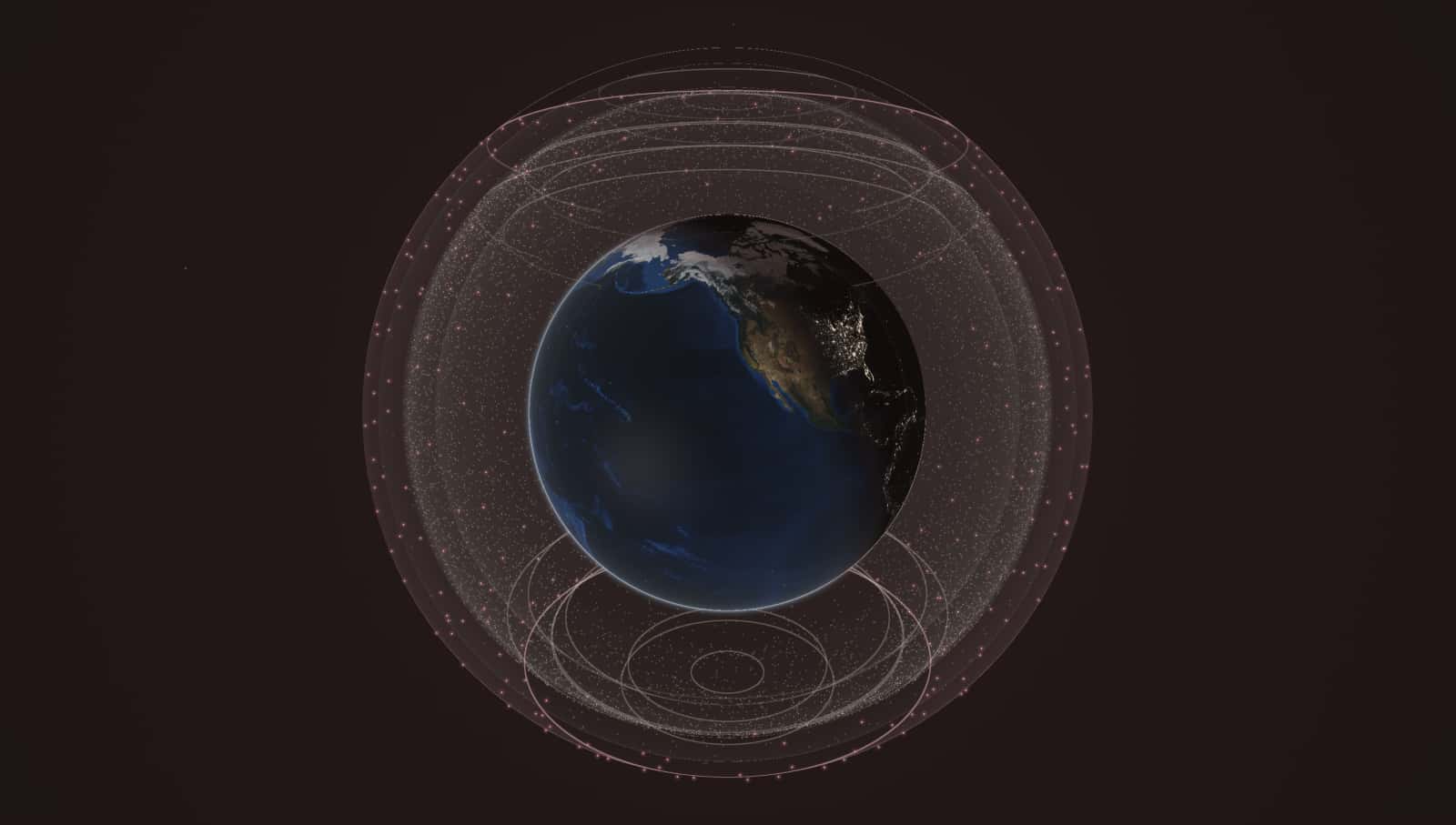
The whole fleet of satellites a network uses, working together.
A LEO network needs a large constellation because each satellite covers only a small patch of ground at a time. More satellites mean fewer gaps in coverage and more capacity to share among the homes below.
On this site Amazon's first-generation FCC license covers 3,232 satellites Confirmed checked . In orbit on Nov 2, 2026, by the same tracker for both (Jonathan McDowell's): Starlink 11,214 satellites Reported checked , Amazon Leo 392 satellites Reported checked . Neither company publishes a live count. The tracker follows Leo launch by launch.
Shell
One layer of a constellation: a group of satellites at the same altitude and the same inclination.
A network spreads its satellites over several shells so that, between them, they cover the latitudes it wants to serve. A license lists each shell's altitude, inclination and number of satellites, and moving a shell usually needs the regulator's approval.
On this site Amazon's first-generation license puts each satellite in one of three shells, at 590 km, 610 km or 630 km Confirmed checked . So far it has filled only the 630 km one.
Inclination
The angle between a satellite's orbit and the equator. It sets how far north and south the satellite travels.
A satellite in an orbit inclined at 52° passes as far north as 52° latitude and as far south as 52° south. Satellites spend the most time near those turning points, so coverage is densest just below the inclination's latitude and runs out a few degrees beyond it, depending on the minimum elevation angle.
On this site Amazon's highest first-generation shell is inclined at 51.9 degrees Confirmed checked , which is why its first network can't reach most of Alaska. See Amazon Leo in Alaska.
Orbit-raising
The climb a new satellite makes with its own thrusters, from where its rocket left it up to its working shell.
Rockets often leave satellites lower than their final orbit, and each one then raises itself over weeks or months. A satellite that is still climbing is in space but not yet in its working position, which is why "launched", "in orbit" and "in service" can be three different numbers.
On this site On Nov 2, 2026, McDowell's tracker listed 12 checked Amazon Leo satellites still raising their orbits. Trackers note that a satellite outside its working orbit may still carry some traffic.
On the ground
Terminal
Also: antenna, dish, kit
The equipment at your home that talks to the satellites: an antenna outside, plus a router or power unit inside.
Starlink sells its equipment as a "kit". Amazon calls its devices terminals and has shown three sizes: Leo Nano, Leo Pro and Leo Ultra. Either way, the antenna needs a clear view of a wide patch of sky, because the satellites it talks to keep moving.
On this site Amazon's terminals for US homes: not on sale in the US Confirmed checked . Amazon's own footer says they have not yet been authorized under FCC rules for sale or lease. Published specs are on the terminals page.
Phased array
A flat antenna made of many small elements that steer its beam electronically, with no moving parts.
LEO satellites cross the sky in minutes, so a home terminal has to keep switching to the next one. A phased array re-aims its beam in a fraction of a second by shifting the timing of the signal across its elements, instead of turning a motor. That is why today's satellite terminals can be flat panels.
On this site Amazon describes Leo Pro as a phased array antenna in its release on the US Army demo of Oct 13, 2026.
Gateway
Also: ground station
A site with large dishes on the ground that links the satellites to the rest of the internet.
A request climbs from your terminal to the satellite overhead, drops to a gateway on the ground, and travels on by fiber; the answer retraces that route. The farther the nearest gateway and data centers are, the longer the delay.
On this site Ookla measured a median latency of 109 ms Confirmed checked for Starlink users in Hawaii in the second half of 2025, well above the mainland, and links it to the distance to ground stations and data centers.
Minimum elevation angle
The lowest angle above the horizon at which a terminal will connect to a satellite.
A higher minimum keeps signals clear of trees, buildings and the thick air near the horizon, but it shrinks the patch of ground each satellite can serve. Together with a shell's inclination and altitude, it sets how far north a network can reach.
On this site Amazon's 2019 FCC technical filing gave 35 degrees Confirmed checked for its terminals; it may have changed since. With the top first-generation shell, that geometry puts the northern edge of coverage at about 58.7 degrees N Our calculation checked .
Performance and rules
Latency
Also: lag, ping
The time a signal takes for a round trip, in milliseconds (ms). Lower is better for calls and games.
Latency is what makes video calls stutter and online games lag, often more than download speed does. It depends mostly on distance: up to the satellite, down to a gateway, and on to the server you're using.
On this site Starlink's US median in Ookla's Q1 2026 data: 39 ms Confirmed checked . Amazon Leo: Not announced checked . Amazon says it will be lower than traditional satellite internet but hasn't given a number.
FCC milestone
A deadline in a satellite license by which a set share of the network's satellites must be in orbit and working.
The FCC uses milestones so that companies don't hold radio spectrum and orbits they aren't using. Missing one would normally cap a license at the satellites in orbit on that date, unless the FCC grants a waiver or an extension.
On this site Amazon's license required 1,616 satellites Confirmed checked in orbit by Jul 30, 2026, and all 3,232 satellites by Jul 30, 2029. It fell well short of the first. On Jun 5, 2026, ahead of the deadline, came the FCC's decision: limited waiver granted, with conditions Confirmed checked . The tracker has the details.
Read next

How these facts were checked
The definitions describe general physics and engineering in plain words. Every Starlink or Amazon Leo number in the 'On this site' notes is a fact from our data files, with its source and the date we checked it.
FCC orders and Census data files are fixed public records whose text can't change, so the "Facts checked" date leaves them out. We read them on Oct 25, 2026; each one is listed at the foot of the page.
Where each fact comes from
- aboutamazon.com/news/innovation-at-amazon/project-kuiper-satell… (primary source) · checked
- ookla.com/articles/starlink-hits-new-us-highs (primary source) · checked
- docs.fcc.gov/public/attachments/DA-26-553A1.pdf (primary source) · checked
- planet4589.org/space/con/star/stats.html (secondary report) · checked
- planet4589.org/space/con/kp/stats.html (secondary report) · checked
- cdn.geekwire.com/wp-content/uploads/2026/02/AmazonLeo-Gen2.pdf (primary source) · checked
- leo.amazon.com (primary source) · checked
- cdn.geekwire.com/wp-content/uploads/2019/07/Kuiper-Technical.pdf (primary source) · checked
- aboutamazon.com/news/innovation-at-amazon/what-is-amazon-projec… (primary source) · checked
- U.S. Army C5ISR completes successful demo of Amazon Leo satellite network, Amazon, published (primary source) · checked